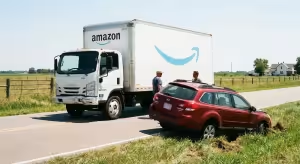
 Amazon delivery vehicles are everywhere in Tampa. Between Delivery Service Partner vans, Amazon Flex drivers in personal vehicles, and semi-trucks running between fulfillment centers, Amazon-related traffic touches nearly every neighborhood in Hillsborough County. When one of those vehicles causes an accident, the first question most people ask is straightforward: can I sue Amazon?
The answer is yes — but Amazon has built its delivery operation specifically to make that difficult. Understanding how Amazon structures its delivery network is essential to understanding how to hold the company accountable.
How Amazon Structures Its Delivery Network
Amazon does not employ most of the drivers who deliver its packages. Instead, it uses two separate systems designed to keep drivers off Amazon’s payroll.
Delivery Service Partners (DSPs) The majority of Amazon package deliveries are handled by DSPs — small companies that contract with Amazon to deliver packages within assigned geographic areas. DSPs hire their own drivers, lease or purchase their own branded vans, and carry their own commercial auto insurance. On paper, the DSP is the employer, and Amazon is simply a client.
In practice, Amazon controls virtually every aspect of how DSP drivers do their jobs. Amazon sets the delivery routes. Amazon dictates the number of packages per route and the expected delivery windows. Amazon requires drivers to use its proprietary Flex app to navigate, scan packages, and confirm deliveries. Amazon monitors driver behavior through an in-van camera system called Driveri and a phone-based safety scoring app called Mentor. Amazon can — and regularly does — terminate DSP contracts for failing to meet performance metrics that Amazon defines.
This level of control is the central issue in litigation. Amazon argues that DSPs are independent businesses and that Amazon has no liability for their drivers’ negligence. Plaintiffs’ attorneys argue that Amazon’s control over how the work is performed — not just what gets delivered — makes DSP drivers Amazon’s de facto employees or, at a minimum, makes Amazon directly negligent for the system it designed and enforces.
Courts across the country have allowed these claims to proceed. Several cases have resulted in significant settlements where Amazon contributed to or funded the resolution, even when the DSP was the named employer.
Amazon Flex Amazon Flex is a gig-economy program where individual drivers use their own personal vehicles to deliver packages. Flex drivers are classified as independent contractors. They receive route assignments through an app, load packages at a delivery station, and complete deliveries within a designated time window.
The liability questions with Flex drivers are different from DSP claims. Because Flex drivers use personal vehicles, insurance coverage is more complicated. A Flex driver’s personal auto policy may deny coverage for accidents that occur during commercial delivery activity. Amazon provides some commercial liability coverage for Flex drivers while they are actively on a delivery route, but the limits and applicability of that coverage are often disputed.
The contractor classification issue also applies to Flex drivers. Amazon sets the delivery window, assigns the route, tracks the driver’s location, and rates driver performance. Whether that level of control transforms a Flex driver into a de facto employee is a fact-intensive question that depends on the specifics of the working relationship.
Why Amazon’s Liability Structure Matters for Your Claim
When an Amazon DSP van or Flex driver causes an accident, Amazon’s first move is to point away from itself. The company will direct your claim to the DSP’s insurance carrier or argue that the Flex driver is an independent contractor whose negligence is not Amazon’s responsibility.
This matters because DSPs are typically small businesses with limited insurance coverage. Many carry the minimum commercial auto liability required by their contract with Amazon. If your injuries are serious — a traumatic brain injury, spinal cord damage, or injuries requiring long-term care — the DSP’s policy alone may not be sufficient to cover your damages. Reaching Amazon’s corporate resources requires establishing that Amazon bears direct or vicarious liability for the crash.
The theories that support holding Amazon liable include:
Vicarious liability through actual control. If Amazon’s control over the DSP driver’s work is extensive enough, courts may treat the driver as Amazon’s employee for liability purposes, making Amazon vicariously liable under respondeat superior.
Direct negligence. Amazon may be directly liable for designing a delivery system that creates unreasonable safety risks — assigning more stops than can be completed safely, imposing time pressures that incentivize speeding and distracted driving, and monitoring driver behavior through metrics that prioritize speed over safety.
Negligent hiring and retention. If Amazon continued contracting with a DSP that had a documented history of accidents or safety violations, Amazon may be liable for failing to vet or terminate that partner.
Florida’s dangerous instrumentality doctrine. When Amazon owns or leases the delivery van and permits a DSP or its driver to operate it, the vehicle owner may bear vicarious liability for harm caused by permissive use of the vehicle. This theory is particularly relevant in cases involving Amazon-branded vans that are leased to DSPs through Amazon’s vehicle program.
Evidence That Matters in Amazon Delivery Accident Cases
Amazon’s technology-heavy delivery system generates extensive data, but the company is not known for voluntarily producing it. Critical evidence in Amazon delivery cases includes route assignments and stop counts from Amazon’s dispatch system, GPS and location data from the Flex app, Driveri camera footage from inside and outside the van, Mentor app safety scores and event logs, the DSP’s contract with Amazon including performance requirements, and the driver’s training records and prior incident history.
Much of this data is controlled by Amazon, not the DSP. Obtaining it requires targeted discovery directed at Amazon’s corporate entities. Preservation demands should be sent to both the DSP and Amazon immediately after the crash — Driveri footage and Mentor app data can be overwritten within days.
What to Do If an Amazon Delivery Vehicle Hit You
If you were struck by an Amazon delivery van or a vehicle driven by an Amazon Flex driver, take these steps:
Get medical attention immediately. Some serious injuries — including brain injuries and internal trauma — may not produce obvious symptoms right away. A prompt medical evaluation creates a documented connection between the crash and your injuries.
Document the vehicle and driver. Note whether the vehicle was an Amazon-branded van or a personal vehicle. Take photos of the van’s markings, license plate, and any Amazon branding. Ask the driver whether they work for a DSP or are a Flex driver — this affects which insurance policies apply.
Do not give a recorded statement to any insurance company. The DSP’s insurer and Amazon’s claims team will contact you. Their goal is to limit what the company pays, not to ensure you are fully compensated.
Contact an attorney before accepting any settlement offer. Early offers from Amazon-affiliated insurers rarely account for future medical costs, lost earning capacity, or the full extent of pain and suffering your injuries will cause. Florida’s statute of limitations gives you two years to file a personal injury claim, but evidence preservation requires immediate action.
Talk to a Tampa Truck Accident Lawyer
Amazon delivery accident claims are more complex than standard vehicle accident cases. Identifying the right defendants, overcoming Amazon’s contractor defense, and accessing the evidence Amazon controls requires attorneys who understand how these cases work.
At Swope, Rodante, Newsome & Steinberg, our Tampa truck accident lawyers have the experience and resources to take on corporate defendants like Amazon. Contact us for a free consultation. We handle these cases on a contingency fee basis — you pay nothing unless we recover for you.