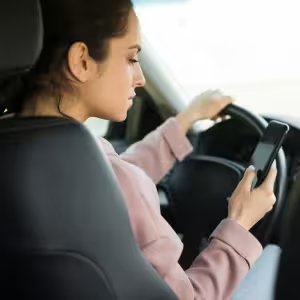
 Distracted driving is the act of operating a vehicle while engaged in any activity that diverts attention from the road. It is one of the leading causes of car accidents in Florida and across the country. Despite growing awareness campaigns and new laws, distracted driving crashes continue to rise as smartphone use becomes more deeply embedded in daily life.
If a distracted driver caused your accident, you can pursue compensation for your injuries. Proving that the other driver was distracted is key.
Types of Distracted Driving
Distraction takes three forms, and texting while driving involves all three simultaneously, making it the most dangerous.
- Visual distraction – Taking your eyes off the road. Looking at a phone, adjusting a GPS, or turning to talk to a passenger are common examples.
- Manual distraction – Taking your hands off the wheel. Reaching for objects, eating, or holding a phone all reduce a driver’s ability to steer and react.
- Cognitive distraction – Taking your mind off driving. Daydreaming, engaging in intense conversations, or processing information on a screen all reduce mental focus on the driving task.
Texting is especially dangerous because it combines all three types. A driver who sends a text looks away from the road for an average of 5 seconds. At 55 mph, that covers the length of a football field with eyes closed.
Florida’s Distracted Driving Laws
Florida Statute § 316.305, known as the Florida Ban on Texting While Driving Law, was updated in 2019 to make texting while driving a primary offense. This means law enforcement can pull a driver over solely for texting, without needing another traffic violation.
Key Provisions
- Texting while driving is a primary offense under § 316.305. A first violation is a non-criminal traffic infraction with a $30 fine plus court costs. A second violation within 5 years carries a $60 fine and 3 points on the driver’s license.
- Handheld phone use in school and work zones is prohibited under Florida Statute § 316.306. Using a handheld wireless device in an active school zone or construction zone is a moving violation that adds 3 points to the driver’s license.
- Hands-free use is generally permitted. Florida law allows drivers to use phones in hands-free mode outside of school and work zones. However, hands-free use still creates cognitive distraction.
Limitations of the Law
Florida’s distracted driving law is narrower than many other states. It focuses primarily on texting and does not broadly prohibit all handheld phone use while driving (except in school and work zones). Other forms of distraction, such as eating, grooming, or adjusting infotainment systems, are not specifically addressed by the statute.
However, any form of distraction that causes an accident can be the basis for a negligence claim regardless of whether it violates a specific statute. Negligence is based on whether the driver exercised reasonable care, and driving while distracted by any activity can constitute a breach of that duty.
Common Distracted Driving Scenarios
- Texting and messaging – Reading or composing texts, emails, and social media messages
- Browsing social media – Scrolling through feeds while driving
- Using GPS and navigation apps – Entering destinations or reading directions on a phone
- Talking on the phone – Even hands-free calls reduce cognitive attention
- Eating and drinking – Managing food and beverages while driving
- Adjusting vehicle controls – Changing radio stations, climate settings, or infotainment systems
- Interacting with passengers – Turning to talk, attending to children, or reaching into the back seat
- Grooming – Applying makeup, shaving, or other personal care while driving
Proving the Other Driver Was Distracted
Proving distraction can be challenging because the other driver will rarely admit they were on their phone. However, several types of evidence can establish distraction.
- Phone records – Subpoenaed cell phone records can show whether the driver was sending texts, making calls, or using data at the time of the crash. Timestamps on messages can be matched to the moment of impact.
- Phone app data – Many apps log activity with timestamps. Social media posts, GPS navigation history, and messaging app data can prove the driver was using their phone.
- Police reports – Officers may note that the driver was holding a phone, that a phone was found in the driver’s lap, or that the driver admitted to using a phone.
- Witness testimony – Other drivers and passengers may have observed the at-fault driver looking down at a phone or otherwise distracted before the crash.
- Dashcam and surveillance footage – Video that shows the driver looking down or holding a device is powerful evidence.
- Accident reconstruction – An expert may determine that the at-fault driver failed to brake or take evasive action, which is consistent with not watching the road.
- Vehicle infotainment data – Modern vehicles log interactions with built-in screens and connected devices that may show the driver was adjusting settings at the time of the crash.
Common Injuries in Distracted Driving Accidents
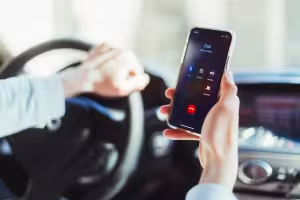 Distracted drivers often fail to brake or slow down before impact because they are not looking at the road. This means the collision occurs at full speed, increasing the severity of injuries.
- Whiplash and neck injuries – Rear-end crashes caused by distracted drivers are the most common cause of whiplash.
- Traumatic brain injuries – Full-speed impacts create forces that cause concussions and more severe brain injuries.
- Spinal cord injuries – High-energy collisions can damage the spine and cause paralysis.
- Broken bones – Fractures to the arms, legs, ribs, and pelvis are common in high-speed distracted driving crashes.
- Soft tissue injuries – Sprains, strains, and tears to muscles, tendons, and ligaments.
- Internal injuries – Organ damage from the force of impact may not be immediately apparent.
Damages in Distracted Driving Accident Cases
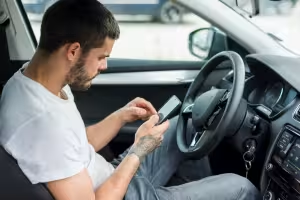 Victims of distracted driving accidents can pursue the full range of damages available under Florida law.
Economic Damages
- Medical expenses – Emergency care, surgery, hospitalization, rehabilitation, and future treatment
- Lost wages – Income lost during recovery and diminished future earning capacity
- Property damage – Vehicle repair or replacement
Non-Economic Damages
- Pain and suffering – Physical pain from your injuries and treatment
- Emotional distress – Anxiety, depression, and fear related to the accident
- Loss of enjoyment of life – Reduced ability to participate in activities you enjoyed before the crash
Punitive Damages
In some cases, a distracted driver’s conduct may be egregious enough to support punitive damages. For example, a driver who was livestreaming on social media while speeding and caused a catastrophic crash may face a punitive damages claim. These damages require showing that the defendant acted with intentional misconduct or conscious disregard for the safety of others.
What to Do After a Distracted Driving Accident
- Call law enforcement. The police report may document evidence of distraction, including the position of the driver’s phone or the driver’s admission of phone use.
- Note the other driver’s behavior. If you saw the driver looking down at a phone, tell the officer. Your observation matters.
- Seek medical attention within 14 days. This preserves your PIP benefits and documents your injuries.
- Photograph the scene. Document vehicle positions, damage, skid marks (or the absence of skid marks, which may indicate failure to brake), and road conditions.
- Do not accept a quick settlement. Insurance companies may minimize distracted driving claims. Wait until the full extent of your injuries is known.
- Contact an attorney. An attorney can subpoena phone records and other electronic evidence before it is deleted or lost.
Frequently Asked Questions
Is texting while driving illegal in Florida?
Yes. Texting while driving is a primary offense in Florida under § 316.305. Using a handheld wireless device in school and work zones is also prohibited under § 316.306.
Can I sue a distracted driver even if they were not cited for distracted driving?
Yes. A traffic citation is helpful evidence, but it is not required to prove negligence. Phone records, witness testimony, and other evidence can establish that the driver was distracted.
How do I get the other driver’s phone records?
In a lawsuit, your attorney can subpoena cell phone records from the driver’s wireless carrier. This is one of the most important reasons to work with an attorney in a distracted driving case.
If a distracted driver caused your accident in Tampa, Swope, Rodante, Newsome & Steinberg can help you gather evidence of distraction and pursue full compensation for your injuries.