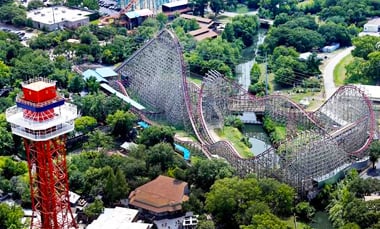
Friday, July 19th, Rosa Ayala-Goana fell to her death at the age of fifty-two while riding a roller coaster at the Six Flags theme park in Dallas, Texas. As her car descended from the first major climb of the Texas Giant roller coaster, Mrs. Ayala-Goana’s harness did not secure her to her seat as the car accelerated downward and dropped out from under her. The medical examiner confirmed that Mrs. Ayala-Goana’s death was caused by the traumatic injuries she sustained in her twelve-story plunge back to Earth.
Witnesses riding in the same car train as the victim report seeing Ayala-Goana rise from her seat as the rides’ restraints lifted open sharply, then locking closed at the bottom of the drop as if there had never been a passenger in the seat. Before the train pulled out from the loading zone, other riders have provided statements that they heard Mrs. Ayala-Goana express concern that her restraints might not have locked properly. Hearing other restraints click at least three times, Mrs. Ayala-Goana informed the operator that her harness had only clicked once, but the operator said that “as long as it clicked, [she was] fine.” Concurrent with eyewitness accounts, amusement park ride safety experts postulate that either the restraint mechanisms failed entirely, or were never properly engaged to begin with.
There are two theories that account for the failure of the safety harness. It is possible that the ride restraints had engaged fully, but failed under the force that Mrs. Ayala-Goana would have naturally exerted as a two-hundred-eighty-pound passenger. Six Flags has company engineers examining the incident currently, but representatives from Germany-based Gerstlauer Amusement Rides arrived this Monday to assist in the investigation. Gerstlauer Amusement Rides has designed and fabricated over fifty cars, and the safety systems they rely on, for theme parks across the U.S.
Gerstlauer has a vested interest in finding that its safety systems were properly functioning so as to retain credibility as the global leader in innovative amusement park ride safety and to avoid a potential product liability lawsuit that could potentially arise. The investigation of the accident may also yield helpful information on Six Flags’ safety inspection processes and whether or not changes need to be made in order to insure an accident like this does not occur again in the future.
Third-party analysts worry that this sets the stage for misinterpretation or misrepresentation of the facts of the accident. The potential for bias in the investigation process stems from the fact that legislation calling for various levels of federal regulation of amusement park rides has been smothered and rejected for the last twenty years. Consequently, it falls to the policies, and policy-makers, of Texas to determine the cause or causes of the roller coaster failure. Texas law on the matter is primarily concerned with “foul play.” If an incident does not feature “a deliberate, directly caused death,” as state investigators found for the Texas Giant incident, it becomes the business of private parties to sort out causality and fault.
If, on the other hand, Six Flags and Gerstlauer find that the safety mechanisms on Mrs. Alaya-Goana’s restraints were indeed functioning properly, then the public’s attention will likely turn towards the ride operators that were responsible for overseeing passenger loading and securing at the time of the accident. Even if Six Flags’ ride operators had no intention of harming Mrs. Ayala-Goana, the company may still be found negligent in a Texas court of law. The National Security Council recorded over 400 serious injuries occurring specifically on roller coasters in 2011. In light of this figure, the Texas Giant’s twelve injuries since 2008 does not indicate that the roller coaster is unusually dangerous or safe. These twelve injuries consisted entirely of neck-muscle strains and minor concussions.
In cases where the professional responsibilities of ride operators clearly should have otherwise prevented the injury, or even wrongful death, of a passenger, Texas law has found the ride operator to be personally at fault. Under certain circumstances; however, the employer can share fault for wrongfully authorizing an under-qualified person. Both floor operators working when Mrs. Ayala-Goana’s car left the loading area had each worked there for more than one month and are therefore assumed under Six Flags’ employee policy to know how to adequately perform their job and keep park guests safe without a more experienced supervisor present. The investigation is still underway and closure is a long ways away for the Ayala-Goana family. The family of Ayala-Goana has not confirmed whether or not they will seek legal representation.