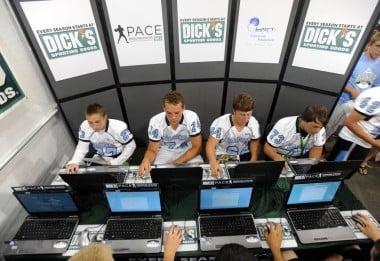
Over the past couple of years, the focus on recognizing and treating concussions has grown immensely amidst a wave of scientific research on concussions. The currently pending NFL concussion lawsuit has also drawn the public’s attention closer to the potential long-term consequences of concussions. In general, parents want to protect their children and ensure their safety – but children who participate in sports like football and hockey face much higher risks of sustaining concussions at young ages.
Among the more popular concussion assessment and treatment tools already in place at the professional level and at the college (NCAA) level is concussion baseline testing. Baseline testing is making its way into many high schools across the US and is being used for varsity and junior varsity athletes in all sports – not just football. One local high school in Tarpon Springs phased in mandatory concussion baseline testing for its student athletes last year, and more and more high schools in Florida and across the US are adding baseline testing this summer in preparation for the coming fall sports season.
An Overview of Concussion Baseline Testing
A new baseline program, known as ImPACT is quickly becoming the standard in school sports programs. This baseline test was created by researchers at the University of Pittsburgh. ImPACT works by running student athletes through a short computer test to measure various cognitive functions. More specifically, the ImPACT system and other, similar baseline testing tools are implemented as follows:
- The test takes approximately 30-45 minutes to administer for each player. Tests are administered before a sports year commences, preferably right before the very first practice.
- Testing is typically administered online or at a school computer, but alternatives for written paper testing can also be used. Basic coordination, cognition, and mental processing exercises and questions are administered to create a pre-season “baseline” assessment of each athlete’s brain functions. The following aspects are measured:
- Reaction Time
- Learning
- Memory
- Ability to Concentrate
- Problem Solving
- Results from the pre-season assessment establish a control or “baseline”. The initial baseline test can sometimes detect the presence of existing, undiagnosed brain injury symptoms. Test results are stored and analyzed for future reference.
- If any one player sustains a suspected concussion, a similar test is re-administered. Test results will help to indicated if any cognitive areas of the brain are impaired by comparing them to the baseline scores. Score disparities help to confirm the presence and severity of a head injury and the need to keep a player removed from activity. In some cases, a player is retested and cannot return to practice or competition until his/her scores on the reassessment return to an acceptable standard.
Effective Concussion Baseline Testing
Provided a concussion baseline testing program is in place, the test is then re-administered within a day or two after a suspected concussion takes place. The outcome of the secondary examination helps to provide healthcare professionals with a detailed insight into areas of the brain that may be injured. A recovery treatment plan can commence immediately upon analysis of the secondary baseline test results.
Only a qualified healthcare professional such as a neurologist or concussion specialist should interpret concussion baseline tests and recommend treatment plans. The Center for Disease Control (CDC) recommends that baseline testing be re-administered in 2 year intervals, at minimum, in cases where no confirmed injuries are reported. In athletes who do sustain a concussion, more frequent test intervals are advised in order to re-establish accurate baselines and to closely monitor the player for changes in his/her condition as well as recurring or persistent symptoms of injury.
References: ImPACT Testing Company, US CDC