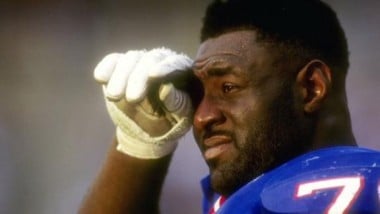
To date, pro Football Hall of Famers Tony Dorsett and Joe DeLamielleure, and former NFL All-Pro Leonard Marshall have each received diagnoses as exhibiting signs of chronic traumatic encephalopathy (CTE), a degenerative condition many scientists and doctors say is caused by repetitive head trauma and is linked to depression and dementia.
The three former stars underwent brain scans and clinical evaluations during the first few months of 2014 at UCLA, as did one additional unidentified ex-player whose test results were not yet available, Last year, UCLA conducted preliminary pilot tests on five other former players and diagnosed all five as exhibiting signs of CTE, setting a precedent as the first time doctors viewed definitive signs of the condition in living test subjects. CTE is indicated by a buildup of tau, an abnormal protein that strangles brain cells in areas that control memory, emotions and other functions. Autopsies of more than 50 ex-NFL players, including Hall of Famer Mike Webster and perennial All-Pro Junior Seau, who died by suicide last year, found such tau concentrations.
According to ESPN’s “Outside the Lines” they notified Dorsett by phone Monday that they had diagnosed him as having signs of the neurological disease. Dorsett’s diagnosis was discussed in a previous Swope, Rodante, Newsome & Steinberg blog posting. The 1976 Heisman Trophy winner and eighth all-time leading NFL rusher said he has trouble controlling his emotions and is prone to outbursts at his wife and daughters. Dorsett said doctors have told him he is clinically depressed. CTE is a disease with no known cure, but Dorsett said he was seeking answers to explain his cognitive and emotional difficulties.
Other CTE Diagnoses and Concussion Stories
Researchers involved in the UCLA testing say their brain scan uses a radioactive marker and a PET scan to identify the signs of CTE in the living, as was done with the eight former players. The research team, in affiliation with a company named TauMark, includes: forensic pathologist Bennet Omalu, who discovered CTE in football players; UCLA psychiatrist Gary Small and pharmacologist Jorge Barrio; and neurosurgeon Julian Bailes, co-director of the NorthShore Neurological Institute in Evanston, Ill.
Joe DeLamielleure noted that how he suffers from anxiety and chronic insomnia, and, like Dorsett, recalled specific instances of mood swings and suicidal thoughts. DeLamielleure, now age 62, said he never received an actual concussion diagnosis during his 13-year career as an offensive lineman for the Buffalo Bills or the Cleveland Browns, but that during games and practices he believes he endured tens of thousands of blows to his head and claims to have suffered at least 100 concussions.
Leonard Marshall, now 52 years old, told ESPN that when he received his diagnosis Sunday it was “very emotional.” He has experienced short term memory loss, erratic behavior and fogginess.
Researchers Race to Develop Additional, more Definitive Tests to Detect CTE in the Living
Other research teams are working to develop more accurate tests to diagnose CTE in patients with a history of concussions who are still alive. Among them is Dr. Ann McKee, a Boston University neuropathologist. No single person has examined more brains of deceased NFL players than McKee, who personally discovered CTE in 47 of the 48 brains she has studied. McKee is also developing a test for the living, but made a point of noting it is not yet clear if currently available scans are actually showing signs of CTE or if they are indicative of other conditions, such as Alzheimer’s disease.
Omalu, also a neuropathologist, stated it is the combination of symptoms, clinical evaluations and brain scan findings that led to his group’s diagnoses of CTE indicators in the former players and that there is a “reasonable degree of certainty that this is CTE until proven otherwise.” He also claims that even in post mortem examinations, a history of cognitive impairment and emotional problems is an important factor in reaching a definitive, accurate CTE diagnosis.
Bailes, a former team physician for the Pittsburgh Steelers, told ESPN he looks forward to further testing and considers his group’s scan a “game-changer.” The first tests, published in a medical journal in February, concluded that Fred McNeill, a 59-year-old former Vikings linebacker; Wayne Clark, a 64-year-old former quarterback for three teams; and three unidentified ex-players: a 73-year-old former guard; a 50-year-old former defensive lineman; and a 45-year-old former center, exhibited probable CTE indicators.
Neurology experts feel UCLA pilot test is a key step toward definitive CTE diagnoses.
References: