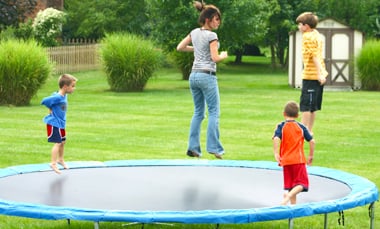
Trampolines are a common sight in backyards of some suburban and rural homes. Some modern trampolines have improved safety features, including a protective net or “fencing” to help prevent jumpers from falling off as well as protective covers on the springs and metal frame. Trampoline sales climbed throughout the 1990s and peaked in 2004, but have since declined.
Despite newer, safer trampolines and a gradual decline in sales, accidents are still common. Severe sprains, fractures, dislocations, spinal cord injuries (SCI) and traumatic brain injuries (TBI) have prompted debates as well as a general recommendations by the American Academy of Pediatrics (AAP) to avoid having trampolines in the home altogether.
Common Trampoline Accident Statistics
Many families still have trampolines in the back yard and indoor trampoline parks have also increased in popularity. Private and public trampolines still pose a risk of injury.
- Between 80,000-100,000 kids ages 1 to 14 are injured on trampolines each year
- 3% to 14% of all trampoline injuries actually require hospitalization
- Kids ages 1 to 14 are the most likely to jump on a trampoline
- Over 75% of injuries occur when multiple jumpers use a single trampoline at the same time. Smaller children are 14 more times likely to get hurt when multiple jumpers are present
- 27% of trampoline injuries occur from falls off of trampolines and nearly 20% occur from contact with trampoline frames and springs. *Newer trampolines equipped with safety netting and padding have been proven ineffective in preventing these injuries from occurring, according to AAP research.
- Despite supervision, nearly half of trampoline injuries occur with an adult nearby
- Serious injuries typically include:
- Deep bruises
- Sprains/strains (wrist and ankle)
- Fractures (ankles, wrists, shins, chest/ribs)
- Head, neck, and spine injuries
- Though relatively rare, serious neck and spinal cord injuries (SCI) can occur. The leading cause of SCI is a jumper’s failed attempt at a somersault, mid-air flip, or other trick
AAP Recommendations for Trampoline Safety
The AAP recommends that parents avoid purchasing a trampoline altogether. Safer, controlled trampoline use may be available through local community and recreational sports-training programs. If parents still decide to install a trampoline, the AAP advises the following:
- Check with your insurance provider to make sure it covers trampoline-related injury claims. Parents may be held liable for any other children who may be injured on the trampoline
- Ensure the trampoline sits firmly on level ground with no legs/supports resting unevenly in a pit or rut. Install the trampoline away from trees, decks, pools, and garages/sheds
- Only install a trampoline with protective netting and padding. These items may help to reduce very minor injuries (cuts, bruises)
- Parents should actively enforce trampoline rules, simply being present will not stop injuries from occurring:
- Only allow one jumper on the trampoline at a time
- Do not allow children to attempt flips or somersaults
- Never allow a child to climb protective netting
- Never allow a child to jump onto the trampoline from a rooftop, ladder, or other stationary object
- Never permit unsupervised use of the trampoline under any circumstances
- Whenever possible, remove the stairs/ladder and secure the netting entrance with a lock or locking cable to discourage unauthorized use. Placing a protective barrier fence (at a safe distance) around the trampoline, with a lockable gate, offers even better protection against unauthorized/unsupervised use
References:
CBS News
Dr. David Geier