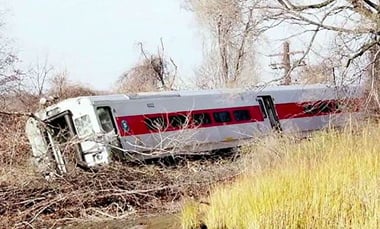
On Sunday, December 1st, a commuter train on its way into New York City was confirmed to be traveling at 82 mph as it entered a curve where the posted speed limit was 30 mph. As a result of excessive speed, the train derailed, according to National Transportation Safety Board investigators. Four people on the train were killed and at least 60 others were injured.
National Transportation Safety Board Investigation Cites Excessive Speed
NTSB board member Earl Weener explained to reporters at a recent news conference how the New York City commuter engine’s throttle wasn’t moved into the “idle” position until about 6 seconds before the locomotive came to a halt, after passenger cars had begun flying off of the rails.
That appropriate reduction of power was “very late in the game,” said Weener. The engine’s brakes, NTSB investigators believe, weren’t properly engaged until about 5 seconds before the engine came to a stop.
Investigators have also determined that the train was exceeding the posted speed limit in the zone immediately preceding the curve. In that zone, “the speed limit was 70 mph,” Weener also noted.
As for whether the accident was the result of human or mechanical error, Weener stated it was too soon to make that particular determination. Later on Monday, following the press conference, the Associated Press reported that:
“It takes about a mile for a train going 70 mph to [safely] stop, according to Steve Ditmeyer, a former Federal Railroad Administration official who now teaches at Michigan State University.”
The NTSB’s investigation into the cause of the New York train derailment began early on Monday and produced results in a matter of hours. Workers could be seen sifting through wreckage. Authorities wanted to be sure they had found everyone on the seven-car train. The train’s black box recorder had been recovered, leading to the NTSB’s determination of excessive speed as the root cause.
When the investigation first begun in the early Monday morning hours, the train’s engineer stated he tried to apply the brakes, according to the New York Daily News.
Gov. Cuomo Addressed Possibly Causes Early On, Calls for Procedure Review
On Sunday evening, before the investigation began, New York Gov. Andrew Cuomo called on federal investigators to look at procedures on the train line. The governor also dismissed early speculation that the track’s curve, which comes just before a station, was the culprit. Governor Cuomo said:
“The curve has been here for many, many years. Trains take the curve every day, 365 days a year. So it’s not the fact that there’s a curve here. We’ve always had this configuration [but] we didn’t have accidents, so there has to be another factor, and that’s what we want to learn from the NTSB. If there’s a change that the MTA can make, that’s great, but first we have to get the results of the investigation. It can’t just be the curve.”
On the following day, NTSB findings confirmed the governor’s speculation that the curve alone was not responsible for the derailment.
Reminiscent of Spain Train Crash
The whole incident was eerily similar to the high-profile train crash that took place in Spain earlier this summer in July. The crash in Spain also involved a passenger train derailment due to excessive speed through a curve. The crash in Spain claimed the lives of at least 79 people and injured hundreds more.
References: