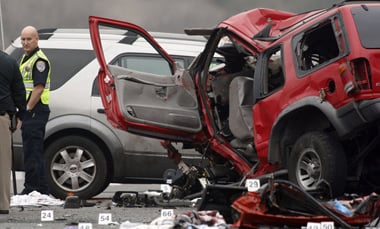
College students injured or killed in wrong-way crashes have been making headlines lately, leading to questions about the risk factors for these accidents and what may be done to keep our kids safe.
On March 16, KVUE.com reported a two-vehicle accident involving a wrong-way driver early Sunday in northwest Harris County, Texas. Jon Fontana was heading east in the westbound lanes of US Highway 290 when he struck a Jeep Liberty carrying four college students in their early 20s. According to deputies, the wrong-way driver, Jon Fontana, died on the scene, and the four Texas A&M students, Denise Martin, Scott Baumgarten, Sarah Lemay, and Franklin Kingsley, were hospitalized.
Last month, in our state, four University of South Florida fraternity brothers; Jobin Joy Kuriakose, 21, of Orlando, Ankeet Harshad Patel, 22, of Melbourne, Imtiyaz Ilias, 20, of Fort Myers, and Dammie Yseudhas, 21 of Melbourne, were killed in a “fiery head-on collision,” on Interstate 275, WUSF News reported. The wrong-way driver, identified as Daniel Lee Morris, 28, was also killed.
Morris had a blood-alcohol level of more than twice the legal limit at the time of the February 9 crash, according to an autopsy released on March 10.
Within two weeks of that crash, another wrong-way crash occurred on I-275, Tampa Bay Times reported. In this crash, only the person who was driving the wrong way, Chase Kaleb Leveille, was killed.
What’s Being Done About Wrong-Way Accidents?
News Channel 8 looked into what Florida was doing about the wrong-way crashes that killed six people on I-275 in two weeks, and found that the Florida Department of Transportation has two pilot programs underway. The first program is along Interstate 10 and uses signs with radar to detect wrong-way drivers that flash “wrong way” if a wrong-way driver is detected. The second program is along the Homestead Extension of Florida’s Turnpike near Miami. This program uses new software that not only detects a wrong-way driver, but also alerts Florida Department of Transportation officials who could contact law enforcement, according to Kris Carson with FDOT.
Still, there is no wrong-way detection technology along Interstate 275. Carson told News Channel 8 that she would contact officials in Tallahassee to find out if they could set up a pilot program in Tampa. However, she said that even “flashing lights” may not be enough to stop a wrong-way driver if impaired.
Statistics on Wrong-Way Driving Fatalities
Unfortunately, the fatalities above are among an estimated average of about 360 lives that are lost each year, a 2012 Wrong-Way Driving Special Investigation Report of crashes from 2004 to 2009, shows.
Though wrong-way crashes are infrequent, accounting for only about 3 percent of accidents, they are much more likely to result in fatal and serious injury than other types of highway accidents, the National Transportation Safety Board analysis of Fatality Analysis Reporting System (FARS) data shows.
While many people may wonder how someone could possibly go down the road the wrong way, it has been a problem for some time even with improvements in signage and pavement markings.
“Driving the wrong way on freeways has been a consistent traffic safety problem since the interstate system was opened in the 1950s,” the 2013 National Wrong-Way Driving Summit website reads. Law enforcement and traffic safety researchers do not fully understand why themselves, but they have found many times alcohol and drugs play a major role, a Sept/Oct. 2002 article by Steve Moler on the Federal Highway Administration’s – Public Roads, “Stop. You’re Going the Wrong Way,” reports.
In addition to driving under the influence, previous studies have identified older drivers because of physical illness or dementia, younger drivers because of skill, and driving fatigue as primary causes.
References
Federal Highway Administration – Public Roads
Illinois Center for Transportation
KVUE ABC
National Transportation Safety Board
National Wrong-Way Driving Summit
WFLA.com