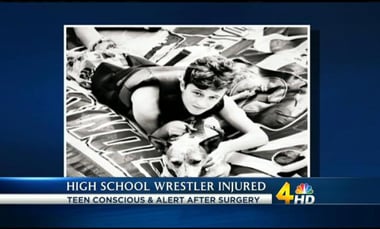
Hunter Garstin, a 15-year-old competitive high school student athlete is recovering from a recent spinal cord injury. Hunter was badly injured during a high school wrestling match in December. With a strong surge of support from his friends and family, Garstin has been working hard at the Shepherd Center in Atlanta on his recovery. At Garstin’s room in the Shepherd Center, his walls are covered with letters and other encouraging mementos sent to him from his hometown in Franklin, Tennessee. Hunter told a visiting reporter, “It’s what motivates me, and drives me. There’s not a single school that hasn’t heard about the accident, they’ve all just been so supportive.”
Hunter has needed that level of support as he struggles to come back from such a sudden, unexpected wrestling injury. He was attending a wrestling meet on December 7th when he unexpectedly lost his footing and fell backwards on the mat. That caused his head upper body to bend forward. Hunter’s mother Emily Garstin explained, “The other guy came down on his neck, just in an awkward position, something that was just a freak accident. That doesn’t really happen in wrestling. He couldn’t feel anything below C6 in his neck. He didn’t have any feeling, no movement.”
Injured Student looks to Friend’s Support and Rehabilitation Progress for Motivation
A few days after an emergency surgery, Hunter was transferred to from a local hospital to the Shepherd Center in Atlanta. According to Hunter, he felt like he was in bad shape and was so nauseous he couldn’t sit up straight. His arms and legs wouldn’t move. And that’s when something clicked, and Hunter realized that he wanted to do something himself. He said, “So, ever since then, I’ve just been, just workout after workout, doing whatever I can. And this place has really been amazing.”
From early morning to late afternoon, Hunter says he pushes himself and looks to the smallest signs of progress for personal inspiration. He pointed out being able to feel his fingers again and moving his middle toe. He has regained sensation in most of his body and now he’s working on regaining control of his arms and legs. Back home at Independence High, Hunter’s schoolmates have rallied behind him – creating special Twitter handles and other types of online support. At a local elementary school, kids too young for Twitter or Instagram videotaped themselves cheering for him. It was not made clear as to whether Hunter’s injury was complete or incomplete, but the fact that he’s regained some sensation in his outer extremities is an encouraging sign for a potential recovery.
The Types of Spinal Cord Injury
Spinal cord injuries commonly result in paralysis below the injury level. In Hunter Garstin’s case, a C-6 vertebrae injury could mean total paralysis from the neck down, with potentially limited sensation or function in the neck and shoulders.
- Complete Injury: In severe cases, a spinal cord may be completely severed, resulting in total paralysis below the injury site. Paralysis of the lower body and lower extremities is called paraplegia, while paralysis in all limbs, with an injury site above the chest or shoulders is called quadriplegia. The effects of a complete injury are permanent and presently irreversible. Researchers have not yet discovered a way to reattach or repair severed spinal tissue.
- Incomplete Injury: Some accidents do not completely severe the spinal cord. Instead, a lateral or “whiplash” effect can produce fractures or even compress the vertebrae. The cartilage discs located between the vertebrae could be displaced, ruptured, or forced into the spinal canal. Any dislocation or damage to vertebrae or discs can place pressure directly on the spinal cord. Blood flow can be temporarily blocked and leaking spinal fluid might also fill the spinal canal, increasing pressure on the spinal cord and causing further damage.
References: